
The strongest Crestron competitors fall into two camps. In commercial AV, the main rivals are Extron, AMX, and QSC’s Q-SYS, with Biamp, Kramer, Atlona, and Utelogy filling specific gaps. In luxury residential automation, Control4 and Savant lead, alongside Lutron, ELAN, RTI, and Vantage. The first question to settle is which camp your project sits in, because a platform built for a 40-room corporate campus is the wrong tool for a home theater, and the reverse is just as true.
Most buyers start looking past Crestron for two reasons: cost and dealer lock-in. We are The Network Installers, a commercial network and AV installation company serving offices, schools, and government facilities, with 19+ years of infrastructure work behind us. We handle commercial AV installation and the network it runs on, and we stay brand-agnostic, so this comparison is not a sales pitch for any single brand. It is how we help commercial buyers pick the right control system for the room and the budget in front of them.
Key Takeaways
- The market splits in two. Commercial AV control (Extron, AMX, Q-SYS) and luxury residential automation (Control4, Savant) are different product classes. Pick your lane before you shortlist a brand.
- Cost drives most switches, not capability. Industry cost guides put a single Crestron room at $15,000 to $50,000, and the programming plus the dealer’s design fee, not the hardware, is usually the biggest line item.
- A truly independent alternative is getting rare. Two of the three top commercial picks now sit inside larger companies: AMX under Samsung’s Harman, and Q-SYS under Acuity. Extron is one of the few still independently owned.
- Dealer lock-in is the hidden cost. Most of these platforms, Crestron included, route every change through a certified dealer. A few (Extron’s no-code tools, Q-SYS, and software-based control) cut that dependency.
- The control brand matters less than the install. The network the system runs on and the quality of the integration decide whether it works. That is where the choice of installer outweighs the choice of box.
13 Crestron Competitors and Alternatives Compared (2026)
This comparison covers both markets in one view. Commercial AV control platforms come first, since that is where most business buyers comparing Crestron will land, followed by the residential and luxury automation systems. Prices are entry-level street figures or documented ranges as of September 2026. Most of this category is quote-only, so treat installed figures as estimates, not published list prices.
| Brand | Market | Best for | Control model | Owner (2026) | Price signal |
|---|---|---|---|---|---|
| Extron | Commercial AV | Standardized rooms rolled out at scale | GUI / no-code (Global Configurator) | Independent | Processor from ~$1,250 |
| AMX | Commercial AV | Enterprise switching in large corporate AV | NetLinx (proprietary code) | Harman (Samsung) | Controller ~$1,510 to $5,835 |
| QSC Q-SYS | Commercial AV | Software-defined audio and AV-over-IP venues | Software on standard server hardware | Acuity Inc. | Entry Core from ~$2,000 |
| Biamp | Commercial AV | Audio DSP for conferencing and paging | DSP hardware plus device control | Highlander Partners | Quote-only |
| Kramer | Commercial AV | Cost-conscious signal switching and extension | Signal management plus light control software | Fortissimo Capital | Switcher from ~$320 |
| Atlona | Commercial AV | AV-over-IP distribution on standard IT networks | Signal distribution plus Velocity software | Hall Technologies | Receiver from ~$696 |
| Utelogy | Commercial AV | Monitoring a mixed fleet of existing systems | Software management layer | Independent | $995 setup plus contract |
| Control4 | Residential | Whole-home automation with a large driver library | Dealer-programmed app ecosystem | Resideo | Controllers $600 to $2,500 |
| Savant | Residential | Apple-centric luxury homes | Dealer-programmed, mobile-first | Savant Systems | Hub from ~$699 |
| Lutron | Residential | Lighting and shading (works with Crestron) | Lighting and shade control | Family-owned | Caseta kit ~$115 |
| ELAN | Residential | Light-commercial and residential custom installs | Dealer-programmed | Nice | Controllers from ~$800 |
| RTI | Residential | Dealer-programmed universal remote control | Dealer-programmed | AVPro Global | Components ~$499 to $1,600 |
| Vantage | Residential | Luxury lighting control in large homes | Dealer-programmed lighting and control | Legrand | ~$4 to $6 per sq ft |
These seven platforms are the real shortlist for a business buyer weighing Crestron for conference rooms, lecture halls, control rooms, or a multi-building campus. They differ most on how they are programmed and how locked-in you are after the install.
1. Extron
Extron is the commercial AV control brand most often named as the direct Crestron alternative, and it is one of the last major players still independently owned. Founded in 1983, it built its reputation on signal management, switchers, and scalers, then layered control on top. Its Global Configurator software is widely considered easier to program than Crestron’s SIMPL, because it leans on a graphical, no-code workflow instead of a full programming language. That lowers the cost of changes and widens the pool of technicians who can service the system.
The catch is buying visibility. Extron gates pricing and reseller information behind a mandatory Extron Insider login, per its reseller policies, so a buyer cannot self-serve a quote or even browse list prices without an account. Its most recent publicly verifiable prices come from a 2022 price sheet, which put the IPCP Pro 250 control processor at $1,250 and a 10-inch TouchLink Pro touchpanel at $2,930. Extron is best for organizations standardizing many similar rooms, where central configuration and monitoring matter more than deep custom programming.
2. AMX
AMX makes enterprise-grade control processors and switching hardware, and it carries a lock-in profile very close to Crestron’s. It is owned by Harman International, which has operated as an independent subsidiary of Samsung Electronics since 2017. AMX programs in NetLinx, its own proprietary language, edited in AMX’s NetLinx Studio environment. That depth rivals Crestron’s SIMPL, which is a strength for complex custom jobs and a drawback if you want to avoid single-vendor programming dependence.
Pricing runs from roughly $1,510 for the NX-1200 huddle-room controller up to about $5,835 for the NX-4200 built for large, high-throughput rooms. AMX is best for large corporate and government AV where heavy signal switching and deep custom control are the point, and where an in-house or contracted NetLinx programmer is already in the picture.
3. QSC Q-SYS
Q-SYS is the modern software-defined alternative, running audio DSP, control, and video-over-IP on standard server-class hardware rather than fixed proprietary processors. That architecture reduces obsolescence risk, since capability is defined in software you can update instead of hardware you have to rip out. QSC, the company behind Q-SYS, agreed to be acquired by Acuity Inc. in 2024, folding it into a much larger parent. So while Q-SYS is often called the independent modern pick, it now sits inside a big company, the same as AMX.
Its limitation is licensing. Core capabilities like added AEC capacity, network audio expansion, and scaling are metered through separate paid feature licenses layered on top of the hardware Core, so the sticker price of the processor is not the whole cost. An entry Core starts around $2,000 on the resale market, while a flagship enterprise Core kit ran around $8,835 before it was discontinued. Q-SYS is best for large venues, higher education, and audio-heavy environments where software-defined flexibility and networked audio carry the design.
4. Biamp
Biamp is an audio-first platform, best known for its Tesira digital signal processing used in conferencing, paging, and large-room audio. It is owned by Highlander Partners, a Dallas private equity firm, which acquired it in 2017. For buyers whose Crestron use is dominated by audio distribution and conferencing, Biamp competes directly on the audio layer.
Where it stops short of Crestron is full room automation. Biamp’s room-control line, Impera, is a device-control layer that drives displays and sources over LAN, RS-232, IR, or GPIO, and Biamp lists scheduling and booking as separate products rather than a single unified automation platform. Tesira hardware is MAP-protected with no public list price, so expect quote-only pricing through authorized dealers. Biamp is best when audio quality and conferencing are the core requirement and full-scene automation is secondary.
5. Kramer
Kramer is a signal-management manufacturer that competes on cost-effective matrix switchers, extenders, and scalers, with a lighter control-software layer on top. It has been majority-owned by Fortissimo Capital, an Israeli private equity fund, since 2021. Its switching hardware is inexpensive relative to full control processors, which makes it attractive for rooms that need reliable AV routing without a heavy control ecosystem.
Its weaker spot is the control software itself. On AVS Forum, integrators have flagged Kramer Control for “constant server outages and downtime and lack of follow through by their customer support team,” so buyers leaning on its cloud control layer should test it hard before committing. A VS-211H2 4K auto-switcher runs about $320, and the KC-Virtual Brain1 control processor about $776. Kramer is best for cost-conscious signal switching and extension where control needs are modest.
6. Atlona
Atlona specializes in AV-over-IP distribution and its Velocity software, which runs control for many rooms from one gateway on a standard IT server rather than a per-room processor. That model appeals to IT-led buyers who want AV to live on the network they already manage. It is a signal-distribution and control-software vendor rather than a deep custom-programming platform like Crestron or AMX.
The risk to weigh is continuity. Atlona’s assets were acquired by Hall Technologies, which recently completed the purchase of substantially all of Atlona’s assets, so the long-term product and support roadmap is still settling. An OmniStream AV-over-IP receiver runs about $696, and a 5×2 4K matrix switcher about $2,996. Atlona is best for distributed AV-over-IP on standard networks where centralized, server-based control fits the IT strategy.
7. Utelogy
Utelogy is not a control processor at all. It is a software management and monitoring layer that plugs into and oversees existing Crestron, Extron, and Q-SYS hardware, so it complements a control system rather than replacing one. It remains independent and privately held. For an organization with a mixed fleet of rooms on different brands, Utelogy offers a single pane to monitor, manage, and report across them.
Its constraint follows from that design: you still need an underlying control system for Utelogy to sit on top of, so it is an addition to the stack, not a Crestron substitute. Pricing starts at a $995 one-time setup fee for up to five rooms, tied to a required 36-month minimum contract per its published price list. Utelogy is best for enterprises standardizing monitoring across an already-installed mix of control platforms.
Residential and luxury automation platforms
These six platforms lead the residential and luxury smart-home market. They matter to commercial buyers mainly when a project straddles hospitality, multi-dwelling residential, or an executive space, or when someone is simply comparing across the whole field. As a commercial installer, we cover them here so the comparison is complete, not because they are the right fit for a corporate AV build.
8. Control4
Control4 is the most direct rival to Crestron for whole-home automation, with the largest driver library in the category and a more mainstream-luxury price point. It is owned by Resideo, which completed its roughly $1.4 billion acquisition of Snap One, Control4’s parent, on June 14, 2024. Its wide driver support means it integrates with more third-party devices out of the box than most competitors.
Its main drawback is dealer dependence. Owners cannot self-service the system, and reprogramming or repairs require a paid dealer visit, a complaint that runs heavily through owner reviews. On the aggregator PissedConsumer, Control4 averages 1.6 out of 5 across 41 reviews, with one owner writing, “I can’t even turn the damn TV on now without calling the dealer.” Controllers run from about $600 to $2,500 (the EA-5 sits near the top), while a focused whole-home install runs $25,000 to $50,000 and a full 4,000 to 6,000 square foot project can reach $100,000 to $250,000, per third-party cost guides. Control4 is best for whole-home residential automation where broad device compatibility is the priority.
9. Savant
Savant builds its experience around a mobile-first, Apple-centric interface, which appeals to households already committed to Apple hardware. It is a privately held company that also owns GE Lighting. For high-end homes that want a polished app experience over deep custom control panels, Savant is a natural Crestron alternative.
Like Crestron and Control4, Savant is dealer-only, with no do-it-yourself path. As one integrator puts it, “Savant can’t be ordered online and set up in an afternoon.” Some owners also report app reliability issues, with one AVS Forum user saying the app “crashes literally half the time I open it.” A home hub runs about $699 on the resale market, while installed whole-home systems run $20,000 to $50,000 at the mid range and $50,000 to $100,000 or more at the high end, per third-party estimates. Savant is best for Apple-centric luxury homes that value app experience over programmable complexity.
10. Lutron
Lutron is a lighting and shading specialist, not a full AV or room-control system, and that distinction matters for anyone shopping it as a Crestron replacement. It integrates with Crestron rather than replacing it. Crestron’s own integration documentation confirms this: “Only Lutron areas that contain keypads that control lights, fans, or shades will be added to the Crestron Home system.” Lutron remains privately held by the founding Spira family. Its lighting and shade control is why Crestron and other platforms integrate with it instead of competing head-on.
So Lutron is a subsystem, not a control brain. It handles lights, shades, and fans, and you still need a control platform to run the AV, climate, and security around it. A Caseta wireless dimmer starter kit lists around $115, while a HomeWorks whole-home professional install runs roughly $15,000 to $25,000 or more, per third-party estimates. Lutron is best for lighting and shading control that plugs into a larger Crestron or third-party system.
11. ELAN
ELAN is a light-commercial and residential automation platform aimed at custom installers, historically competing with Crestron on more modest budgets. It is owned by Nice, the Italian company that acquired parent Nortek Control in 2021. The picture here is mixed and worth stating plainly: the ELAN corporate and dealer brand was dissolved into Nice North America around 2023, yet the ELAN OS product name survives and is still being developed, with ELAN OS 9 shown at ISE 2026.
That transition created a support gap for some existing owners. On AVS Forum, one legacy g! system owner reported that “the company I worked with no longer has an Elan technician,” which is the kind of continuity risk to check before buying into any platform mid-rebrand. Public pricing is dated, with older listings showing a g1 controller near $800 and a gSC10 system controller near $2,100, so verify current pricing with a dealer. ELAN is best for light-commercial and residential custom installs where a local Nice dealer can confirm ongoing support.
12. RTI
RTI (Remote Technologies Incorporated) is a dealer-programmed control platform known for its universal remotes and custom control interfaces, targeting residential and light-commercial jobs. It entered a new ownership chapter when AVPro Global announced a definitive agreement to acquire it on May 29, 2025. Its strength is flexible, dealer-tuned control across AV, lighting, and more at a lower entry cost than Crestron.
Its constraint is strict dealer-only distribution, and buying outside authorized channels voids the warranty, so gray-market savings carry real risk. Component prices run from about $499 for a T2i remote to roughly $1,600 for an XP-series processor, with a full system commonly landing between $2,500 and $10,000 or more before install labor, per third-party estimates. RTI is best for dealer-programmed universal remote control in homes and small commercial spaces.
13. Vantage
Vantage is a luxury lighting-control and automation brand owned by Legrand, positioned as a high-end option for large homes. It competes with Crestron mainly on the lighting-control and whole-home side rather than commercial AV. For upmarket residential projects, it offers deep lighting scenes and integrated control through a certified dealer.
Vantage is a closed, dealer-only ecosystem with no do-it-yourself or retail purchase path and no self-service programming, so you are committed to a dealer relationship for the life of the system. As one integrator community member noted, “I haven’t heard of anyone DIYing Vantage, but if you can strike a deal, the dealer may give you software and control.” Third-party estimates put its added cost at roughly $4 to $6 per square foot over standard switches. Vantage is best for luxury lighting control in large homes handled through a dedicated dealer.
Why Buyers Look for Crestron Alternatives
Buyers leave Crestron mostly over cost and control, not because the platform lacks capability. Crestron is the market leader and can do nearly anything, which is exactly why it sits at the top of the price range.
The first driver is total cost. Industry cost guides put a single Crestron room at $15,000 to $50,000, and on most jobs the hardware is not the biggest line item. The programming and the dealer’s design fee are. That is what pushes cost-sensitive buyers toward Extron’s no-code tools or software-defined Q-SYS, where changes are cheaper and faster to make.
The second driver is dealer lock-in. On most of these platforms, Crestron included, every change routes through a certified dealer. Want to move a button or rename a scene? That can mean writing a check, waiting days or weeks, and scheduling a site visit. Some integrators report paying around $7,000 just to add a unit and reprogram an existing system. Platforms with graphical configuration or software-based control reduce that dependency, which is often the real reason a buyer switches.

A third, newer factor is independence. The AV control market has consolidated fast. AMX sits under Samsung’s Harman, Q-SYS under Acuity, Control4 under Resideo, and Atlona under Hall Technologies. If long-term roadmap stability and avoiding a single-vendor lock matter to you, the ownership behind each platform is now part of the decision, not a footnote.
How to Choose a Crestron Alternative
Choosing well comes down to matching the platform to the project, then getting the installation right. Work through five questions in order.
- Commercial or residential? Settle this first. Extron, AMX, and Q-SYS are built for commercial AV. Control4, Savant, and Vantage are built for the home. Picking across the line is the most common and most expensive mistake.
- How much dealer dependence can you accept? If you want to make your own changes, favor graphical or software-based control (Extron, Q-SYS, Atlona) over proprietary code (Crestron’s SIMPL, AMX’s NetLinx).
- What is the licensing model? A low hardware price can hide recurring or add-on costs. Q-SYS meters capability through feature licenses. Utelogy runs on a multi-year contract. Read past the sticker price.
- Who owns the platform, and how stable is the roadmap? After a wave of acquisitions, ask what happens to product lines and support if the parent shifts strategy. This is a real risk for anyone buying a system meant to last a decade.
- What is the network underneath? This is the one buyers overlook. Modern AV control, especially AV-over-IP and software-defined platforms like Q-SYS and Atlona Velocity, runs on your LAN. The control brand will not fix a bad installation or an unreliable network. The integration, the cabling, and the network design decide whether the system works.
That last point is where a brand-agnostic installer earns its keep. We handle commercial AV installation and build the network and structured cabling these systems run on, and we stay brand-agnostic, so the recommendation follows the room and the budget, not a brand quota. For a broader look at how we approach vendor trade-offs, see our Cisco Meraki alternatives guide.
Also read: Juniper Mist Alternatives & Competitors
Frequently Asked Questions
Who are Crestron’s main competitors?
Crestron’s main competitors are Extron, AMX, and QSC’s Q-SYS in commercial AV, and Control4 and Savant in luxury residential automation. Extron and AMX compete on control processors and switching, Q-SYS on software-defined audio and AV-over-IP, and Control4 and Savant on whole-home automation. Biamp, Kramer, Atlona, Utelogy, Lutron, ELAN, RTI, and Vantage compete in narrower slices such as audio, signal distribution, monitoring, or lighting.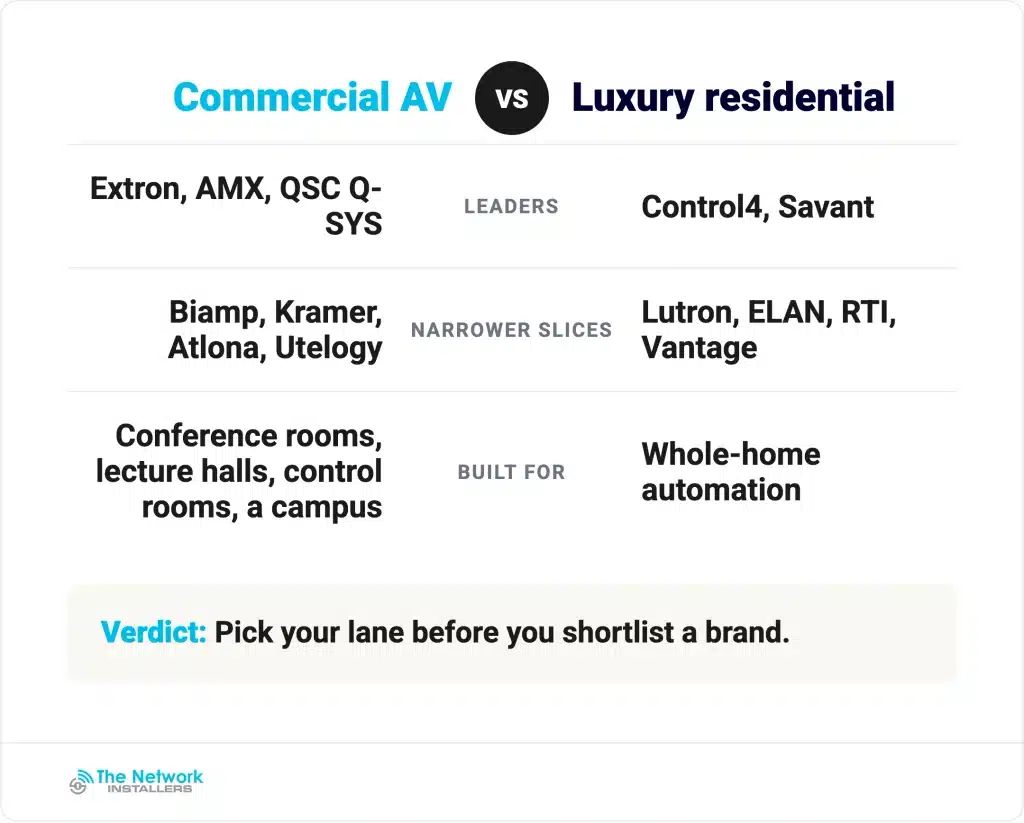 The market splits in two, and which camp the project sits in decides the shortlist.
Is Crestron or Control4 better?
Neither is universally better, because they target different markets. Crestron leads in commercial AV and high-end custom projects, while Control4 is built for whole-home residential automation and is generally more accessible for mainstream luxury homes. For a corporate boardroom or a campus, Crestron or a commercial rival like Extron or Q-SYS fits. For a house, Control4 is the more common and more affordable choice.
Is Crestron or Savant better?
Crestron suits complex commercial and custom installations, while Savant suits luxury homes that want an Apple-centric, mobile-first experience. Savant’s interface is polished and app-driven, which many homeowners prefer, but both are dealer-only systems with no do-it-yourself path. The better choice depends on whether the project is commercial (lean Crestron) or a design-forward home (consider Savant).
Does Lutron replace or work with Crestron?
Lutron works with Crestron rather than replacing it. Lutron is a lighting and shading specialist, and Crestron integrates Lutron’s keypads for lights, fans, and shades into a Crestron Home system. You still need a full control platform to run AV, climate, and other subsystems, so Lutron is a specialist subsystem, not a Crestron substitute.
Why is Crestron so expensive?
Crestron is expensive because the hardware is only part of the cost. A single room commonly runs $15,000 to $50,000, and the programming labor plus the dealer’s design fee often exceed the price of the equipment. Custom SIMPL programming and mandatory dealer involvement for changes add ongoing cost over the life of the system.
Is there a cheaper alternative to Crestron?
Yes. In commercial AV, Extron’s no-code tools and QSC’s software-defined Q-SYS often cost less to program and maintain, and Kramer offers inexpensive signal switching. In residential, Control4, RTI, and ELAN typically come in below a comparable Crestron build. Software-based control platforms that reduce dealer dependence are a growing lower-cost category as well.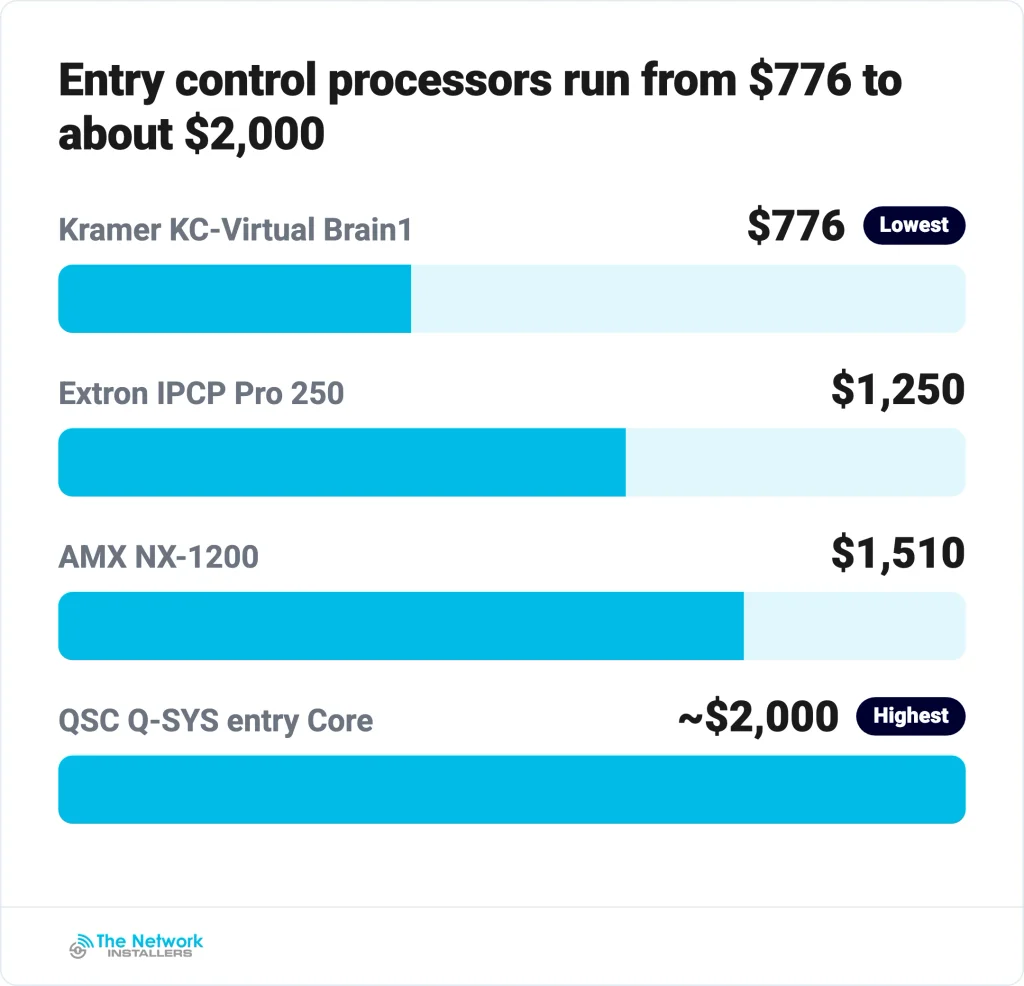 Entry control-processor prices named in this guide. Most of this category is quote-only, so treat them as estimates rather than published list prices, and note that a low hardware price can hide recurring or add-on costs. The Extron figure comes from its most recent publicly verifiable 2022 price sheet.
The Bottom Line
The best Crestron competitor depends first on your market. In commercial AV, Extron, AMX, and Q-SYS are the serious rivals, with Biamp, Kramer, Atlona, and Utelogy covering audio, signal distribution, and monitoring. In luxury residential, Control4 and Savant lead, with Lutron, ELAN, RTI, and Vantage filling specific roles. Cost, dealer lock-in, and, increasingly, who owns each platform are what separate them.
The harder truth is that the control brand is rarely what makes or breaks a system. The network it runs on and the quality of the integration do. As The Network Installers, a commercial network and AV installation company serving offices, schools, and government facilities, we handle commercial AV installation and build the network and cabling these systems run on, backed by 19+ years in business and more than 20,000 locations served. We stay brand-agnostic, so our recommendation fits the room and the budget instead of a sales quota. If you are comparing control systems for a commercial project, contact our team to talk through the right fit before you buy.
Sources
- Crestron: Lutron Integration documentation
- Harman: Is Harman owned by Samsung?
- QSC: Acuity acquisition
- Q-SYS: Scaling Feature Licenses
- Extron: Reseller Policies
- Wikipedia: NetLinx
- Highlander Partners: Biamp acquisition
- Kramer: Fortissimo Capital acquires controlling stake
- Atlona: Hall Technologies acquisition
- Resideo: Completes Acquisition of Snap One
- PissedConsumer: Control4 reviews
- CE Pro: Nortek Control rebrands as Nice North America
- Strata-gee: AVPro Global acquires RTI
- Residential Systems: Lutron to Remain Family-Owned
- Legrand: Acquisition of Vantage