

Smart building trends are revolutionizing how we design, operate, and experience commercial and residential spaces. As businesses seek greater efficiency, sustainability, and occupant satisfaction, smart building technology has emerged as an essential infrastructure investment.
Market Growth Snapshot: The global smart building market, valued at $117.4 billion, is projected to reach $548.5 billion by 2032, representing unprecedented growth driven by IoT integration, AI-powered systems, and advancing automation technologies.
For building owners and facility managers, understanding these building trends isn’t just about staying current—it’s about making strategic decisions that impact operational efficiency, cost management, and competitive positioning for years to come.
What Is Smart Building Technology?
Smart building technology encompasses interconnected systems that use IoT sensors, artificial intelligence, and building automation to optimize building operations, enhance occupant experiences, and improve energy efficiency. These intelligent systems collect real-time data from various building systems—including HVAC, lighting, security systems, and occupancy sensors—to make automated adjustments that reduce operational costs and improve building performance.
Key Differentiator: Unlike traditional buildings, where building systems operate independently, smart buildings create synergistic relationships between different systems that can coordinate their operations for maximum efficiency.
Top Smart Building Trends and Statistics

IoT Integration in Smart Buildings
The Internet of Things represents the foundational layer of smart building functionality, with projections showing that IoT devices in commercial buildings will reach 4.12 billion by 2030.
What This Scale Means: This unprecedented deployment of sensors, connected devices, and wireless systems creates comprehensive building intelligence networks that monitor:
- Occupancy patterns and movement flows
- Energy consumption in real-time
- Air quality conditions
- Equipment performance metrics
IoT gateways serve as critical communication hubs that bridge different protocols and ensure seamless data flow between systems, enabling predictive maintenance, automated environmental adjustments, and data analytics that inform operational decisions.
AI-Powered Building Management Systems (BMS)
Market Insight: The AI in smart buildings market, valued at $13.4 billion, is growing at 21.58% annually as organizations recognize the powerful capabilities of intelligent systems.
Proven Results: AI driven algorithms analyze patterns in equipment performance, occupancy data, and environmental conditions to optimize building operations automatically. Case studies demonstrate remarkable outcomes:
- 15.8% energy reduction achieved in a 32-story office building through AI-enabled HVAC optimization
- Over $42,000 in annual savings generated while significantly reducing carbon emissions
- Continuous performance improvements through machine learning from historical data
Key Takeaway: Machine learning enables building management systems to become more efficient and responsive over time, creating building environments that continuously optimize themselves through advanced data analytics.
Sustainable and Green Building Technologies
Sustainability has become a primary driver for smart building adoption, with energy efficiency and environmental performance increasingly critical for regulatory compliance and corporate responsibility.
Energy Performance Results:
- 20-30% energy savings through integrated system optimization
- 35-40% electricity reduction from smart lighting systems
- 20-25% HVAC efficiency improvements through AI driven controls
- Up to 50% reduction in comprehensive smart building retrofits
Technology Integration: Smart buildings embrace advanced technologies, including:
- LED lighting systems with automated controls
- Intelligent HVAC systems with predictive algorithms
- Comprehensive energy management systems platforms
- Precise tracking of energy consumption, water usage, and indoor air quality monitoring
Regulatory Impact: Green building certification requirements are accelerating smart building adoption, as these technologies provide the monitoring and optimization capabilities necessary to meet strict environmental standards.
Smart Security and Access Control
Security systems in smart buildings have evolved far beyond traditional approaches to incorporate AI-powered surveillance, behavioral analysis, and integrated access control.
Advanced Security Systems Capabilities:
- AI-powered threat detection with real-time analysis
- Behavioral pattern recognition for unusual activity identification
- Computer vision technologies for sophisticated surveillance analysis
- Biometric access control with fingerprint and facial recognition
- Mobile-based access systems for flexible, secure entry management
Integration Benefits: Modern security platforms can coordinate multiple systems simultaneously, such as automatically adjusting HVAC settings, modifying lighting levels, and updating security monitoring based on detected changes in building occupancy patterns.
Cloud-Based Building Management Solutions
The transition to cloud-based building management represents a fundamental shift from traditional on-premises systems to scalable, remotely managed platforms utilizing cloud computing.
Cloud Platform Advantages:
- Automated management capabilities with minimal manual intervention
- Centralized data storage and analytics across multiple properties
- Enhanced security features through enterprise-grade cloud services
- Real time monitoring and control capabilities
- Coordinated optimization strategies across entire building portfolios
Cost Benefits: Cloud-native systems eliminate expensive on-premises server infrastructure while reducing ongoing IT maintenance requirements through subscription-based pricing models that improve cost predictability and lower operational costs.
Digital Twin Technology in Smart Buildings
Industry Adoption: 62% of organizations report that digital twin technology provides “immense value” to their operations, transforming how buildings are monitored and optimized.
Core Capabilities: Digital twin technology creates virtual replicas of physical buildings that enable comprehensive simulation, analysis, and optimization throughout the building lifecycle. These dynamic models:
- Integrate real-time sensor data with historical performance information
- Enable testing of operational scenarios without disrupting actual building operations
- Support predictive modelling for maintenance, upgrades, and operational strategies
- Provide unified platforms for data integration, analysis, and control across all building systems
Strategic Value: Rather than managing separate interfaces for HVAC, lighting, security, and other building functions, facility managers can monitor and control all systems through a single digital twin interface that shows the relationships and interactions between different building components.
5G and Smart Building Connectivity
Fifth-generation wireless technology is enabling unprecedented connectivity and data transmission capabilities for smart building systems.
5G Enhancement Capabilities:
- Massive IoT device support for comprehensive building intelligence
- Ultra-low latency for mission-critical applications
- High reliability for continuous system operation
- Real-time coordination between various building systems
- Advanced application support, including augmented reality maintenance interfaces
Practical Applications: Enhanced connectivity enables sophisticated applications like high-definition security video streaming, instantaneous emergency response communications, and real-time building system coordination that was previously impossible with traditional network infrastructure.
Smart Workspace and Occupant Experience
Smart buildings are increasingly focused on optimizing occupant experiences through intelligent workspace management, personalized environmental controls, and advanced amenity systems.
Utilization Reality Check: Industry research reveals significant space utilization optimization opportunities:
- Global average utilization of assigned seats: Only 60%
- Meeting room utilization average: Just 30%
- Productivity increase: 2% despite average workdays shortening by 36 minutes
User-Centric Technologies:
- Occupancy sensors providing detailed space utilization insights
- Mobile applications for personalized environment customization
- Voice-activated controls for intuitive system interaction
- Real-time feedback systems for continuous building optimization
- Data-driven decision-making based on actual usage patterns
Business Impact: This focus on user experience is driving higher tenant satisfaction and increased property values, with smart buildings commanding 5-10% higher rental premiums compared to traditional buildings.
Key Features of Smart Buildings
Smart buildings incorporate several essential features that distinguish them from traditional building systems:
Core Smart Building Technologies:
- Automated Environmental Controls – Adjust lighting, temperature, and ventilation based on occupancy patterns and external conditions
- Predictive Maintenance Systems – Analyze equipment performance data to schedule maintenance proactively and prevent equipment failures.
- Integrated Security Platforms – Combine surveillance, access control, and emergency response systems into unified management interfaces
- Energy Optimization Systems – Monitor consumption patterns and automatically adjust operations to minimize energy waste.
- Real Time Monitoring Capabilities – Provide comprehensive visibility into building performance
- Mobile Management Platforms – Enable remote monitoring and control from anywhere.
Challenges in Implementing Smart Building Technology

Cybersecurity Vulnerabilities
Security Alert: Research shows 38% of smart buildings have experienced cyberattacks, with 75% of building management systems vulnerable to hacking or cyber threats.
Major Risk Factors:
- Interconnected systems create expanded attack surfaces.
- Legacy building protocols often lack robust security features.
- Average cyber breach cost: $4.67 million globally ($9.6 million in the US)
- Ransomware incidents: Average $1.76 million per attack
- Downtime costs: $350,000 per hour in lost revenue
Proactive Security Measures:
- Strong authentication protocols with multi-factor verification
- Encryption for all data transmission and storage
- Network segmentation to isolate building systems
- Continuous monitoring systems for threat detection
- Regular security audits and vulnerability assessments
Interoperability Issues
Current Challenge: Most commercial buildings operate with disconnected systems where HVAC, lighting, and security components cannot communicate effectively, creating barriers to comprehensive building automation.
Industry Cost Impact: Inadequate interoperability imposes approximately $15.8 billion in annual costs on the US capital facilities industry, representing 1-2% of total industry revenue.
Solution Progress: Substantial advancement through open standards:
- BACnet and KNX protocols for system integration
- Data modelling frameworks like Brick Schema and Project Haystack
- Open-source platforms breaking down proprietary barriers
- Standardized APIs enabling better integration between manufacturers
Cost Barriers
Investment Challenges: High initial investments remain significant barriers, particularly for smaller organizations with limited capital budgets.
ROI Success: Organizations that approach implementations strategically often achieve positive ROI within 1-3 years through energy savings, operational efficiency improvements, and enhanced asset values.
Financial Benefits Breakdown:
- Energy cost reductions: 20-30% typical cost savings
- Maintenance optimization: 25-30% cost reduction
- Equipment lifespan extension: 20-40% longer operational life
- Property value increase: 5-10% premium over traditional buildings
- Return ratio: Approximately $3 return for every $1 invested over five years
Cost-Reduction Solutions:
- Cloud computing platforms are reducing upfront infrastructure costs
- Software-as-a-service models for advanced capabilities access
- Phased implementation approaches spread costs over time
- Performance-based contracts aligning vendor incentives with results
Future Outlook of Smart Building Technology
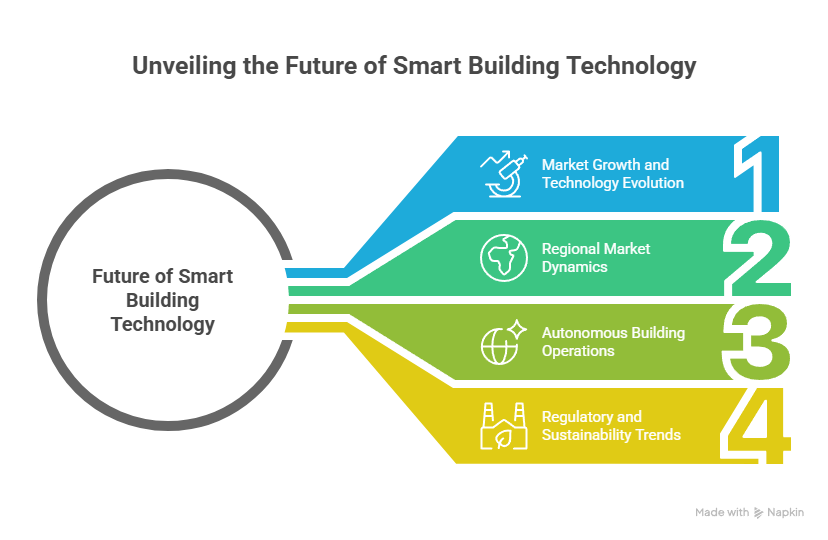
Market Growth and Technology Evolution
Extraordinary Growth: Even conservative estimates project the global smart building market will more than double within the next decade, driven by compelling ROI metrics, regulatory pressures, and operational benefits.
Regional Market Dynamics:
- North America: Maintaining 35-43% market leadership through advanced infrastructure
- Asia Pacific: Fastest-growing region driven by rapid urbanization and smart cities initiatives
- Europe: 30.5% market share supported by EU sustainability initiatives
- Emerging Markets: Significant opportunities in Latin America, the Middle East, and Africa
Technology Maturation Factors:
- Decreasing costs are making solutions accessible to smaller buildings
- Improved reliability, building confidence in smart building systems
- Enhanced capabilities delivering greater value propositions
- Regulatory support creating favorable adoption environments
Autonomous Building Operations
The evolution toward autonomous building operations represents the next frontier, with AI systems becoming capable of managing complex building functions with minimal human intervention and evolving rapidly.
Autonomous Capabilities:
- Integrated predictive maintenance with automated scheduling
- Dynamic energy optimization responding to real-time conditions
- Automated space management adapting to usage patterns
- Comprehensive tenant services through AI-powered systems
Strategic Implications: These autonomous automation systems will enable building systems to respond more effectively to dynamic conditions while reducing operational costs and improving system reliability through optimal performance.
Regulatory and Sustainability Trends
Environmental Regulation Impact:
- Stricter energy efficiency standards are driving smart building adoption
- Carbon reduction requirements necessitate optimization technologies
- Smart cities initiatives incorporating intelligent buildings as foundational elements
- Compliance documentation through automated reporting systems
Market Driver Effect: Environmental regulations create compelling business cases for smart building technologies while providing market advantages for early adopters who develop expertise with compliance-supporting systems and enhance energy efficiency.
Also read: Building Automation System Market Statistics
FAQs
How do smart buildings save energy?
Smart buildings achieve energy savings of 20-30% through integrated systems that optimize HVAC, lighting systems, and equipment operations based on real-time data and environmental conditions. AI algorithms analyze patterns and automatically optimize energy usage to minimize waste while maintaining optimal comfort levels. Advanced implementations can achieve up to 50% energy reduction through comprehensive automation and predictive optimization.
Are smart buildings more secure than traditional buildings?
Smart buildings can provide enhanced security through AI-powered surveillance, integrated access control, and real-time threat detection capabilities. However, they also create new cybersecurity vulnerabilities that require comprehensive security strategies, including encryption, network segmentation, and continuous monitoring. While physical security is typically enhanced, cybersecurity risks increase and must be actively managed through proper protocols and systems.
What industries benefit most from smart building technologies?
Commercial buildings, healthcare facilities, educational institutions, and industrial facilities see the greatest benefits from smart building technology. These sectors have high operational costs, strict regulatory requirements, and significant opportunities for efficiency improvements that justify smart building investments. Healthcare facilities particularly benefit from air quality monitoring and compliance automation, while office buildings see substantial gains in energy efficiency and tenant satisfaction.
What is the typical ROI timeframe for smart building investments?
Well-planned smart building implementations can achieve positive ROI within 1-3 years through energy savings, operational efficiency improvements, and enhanced asset values. The key is implementing integrated systems that deliver comprehensive benefits rather than isolated technologies. Organizations typically see approximately $3 in returns for every $1 invested over five-year periods, with energy savings of 20-30% providing immediate and ongoing financial benefits.
How do smart buildings address sustainability requirements?
Smart buildings support sustainability goals through precise energy monitoring, automated optimization of resource consumption, and comprehensive reporting capabilities that demonstrate progress toward environmental goals. Many smart building solutions directly support LEED certification requirements and other green building standards by providing the data collection and system optimization necessary for compliance. Advanced systems can reduce energy consumption by 20-50% while providing detailed documentation for sustainability reporting.
What role does edge computing play in smart buildings?
Edge computing enables real-time processing of building data without dependence on cloud connectivity, reducing latency for critical systems like security, emergency response, and HVAC controls. This local processing capability ensures continued operation even when internet connectivity is interrupted while enhancing data privacy and system responsiveness. Edge computing is particularly important for applications requiring immediate responses, such as security threat detection and emergency system activation.
How do occupancy sensors improve building efficiency?
Occupancy sensors provide real time data about space utilization, enabling buildings to automatically adjust lighting, HVAC, and other systems based on actual occupancy rather than predetermined schedules. This can result in 20-30% energy savings while improving occupant comfort. Modern sensors use multiple detection technologies while maintaining privacy protection, providing detailed insights that support both immediate operational optimization and strategic space planning decisions.
On A Final Note
Smart building trends are fundamentally transforming how we design, operate, and experience built environments. The convergence of IoT, artificial intelligence, and automation systems is creating unprecedented opportunities for operational efficiency, cost reduction, and occupant satisfaction. While implementation challenges around cybersecurity, interoperability, and costs remain significant, the smart building industry has developed mature smart solutions and best practices that enable successful deployments.
Market Reality: The projected growth from $117.4 billion to $548.5 billion by 2032 reflects demonstrated value creation through energy savings of 20-30%, maintenance cost reductions of 25-30%, and return ratios of approximately $3 for every $1 invested over five-year periods.
Implementation Success: Organizations achieving the greatest benefits approach smart building investments strategically, with comprehensive planning, phased implementation, and focus on measurable outcomes rather than pursuing technology for its own sake. The evolution toward autonomous building operations, enhanced regulatory compliance capabilities, and sophisticated tenant experience optimization indicates that smart building systems will transition from competitive advantages to baseline requirements for commercial real estate success.
Strategic Opportunity: For organizations considering smart building investments, the key is approaching these technologies strategically with clear business objectives, comprehensive security planning, and a focus on integrated systems that deliver measurable benefits. As the market continues expanding toward $548.5 billion by 2032, early adopters position themselves advantageously for competitive performance and regulatory compliance in an increasingly demanding market environment.
We guide organizations through the complexities of smart building technology with end-to-end network infrastructure solutions that enable intelligent systems. Our expertise in data cabling, fiber optic installation, and structured cabling provides the foundational connectivity that enables smart building technology to deliver its full potential. Our experience with network infrastructure design ensures that buildings have the robust, scalable connectivity necessary to support current smart building requirements while accommodating future technology evolution and expansion needs.
Citations:
[1] https://www.gminsights.com/industry-analysis/smart-building-market
[2] https://memoori.com/trends-powering-smart-buildings-4bn-iot-devices-2030/
[3] https://www.futuremarketinsights.com/reports/smart-building-market
[4] https://www.databridgemarketresearch.com/reports/global-smart-building-market
[5] https://www.precedenceresearch.com/smart-building-market
[6] https://straitsresearch.com/report/smart-building-market
[7] https://www.fortunebusinessinsights.com/industry-reports/smart-building-market-101198
[8] https://market.us/report/smart-building-market/
[9] https://smartbuildingmag.com/market-overview/68658-energy-saving-in-smart-buildings
[10] https://r-valueassociates.com/blog/the-long-term-roi-of-energy-efficient-building-products/


